Questions
Specifier FAQ
Does geofoam need compaction?
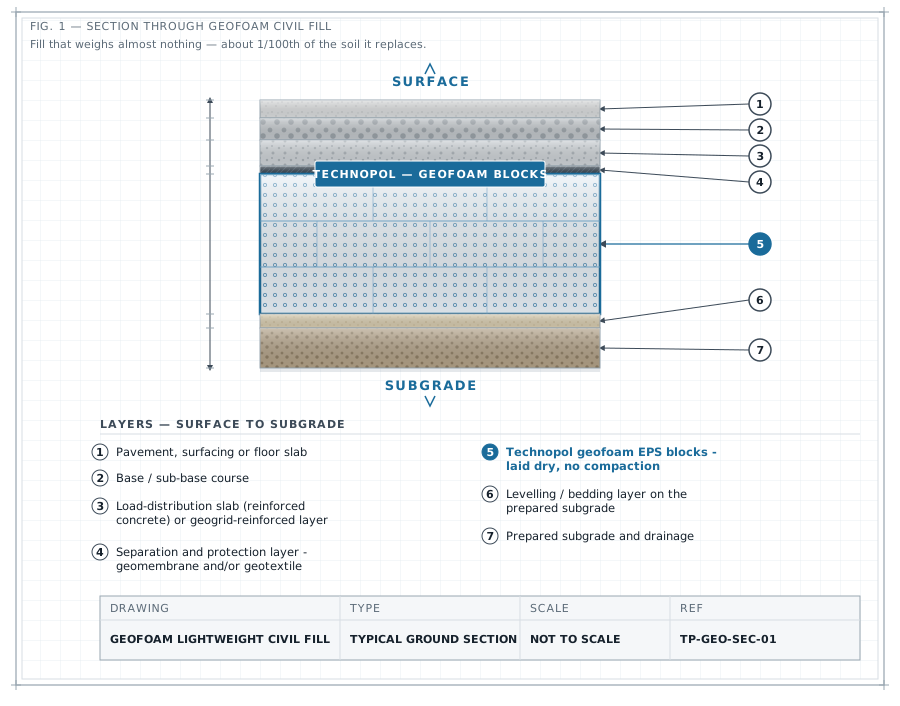
No. It is placed dry as rigid blocks in staggered, mechanically inter-connected courses — no compaction, no moisture conditioning, no layer-by-layer density testing. That is exactly why it is used where a compacted fill would surcharge soft ground or a buried structure.
How do I choose the grade?
Work out the sustained stress arriving at the top of the block once the load-distribution slab has spread it, then pick the grade whose compressive resistance @1% strain exceeds it. The @1% ladder is 15 / 17 / 45 / 70 / 100 kPa for EPS12 / 15 / 20 / 24 / 30. Never size against the @10% strengths (60–200 kPa) — those are failure-region values and designing to them causes long-term creep.
Will it float?
Yes, if you let it. At 12–30 kg/m3 the fill is far lighter than water, so uplift is often the governing check. Keep the base above the design groundwater level, drain the surrounds, and confirm the permanent overburden exceeds the buoyant force at the design flood level with the engineer's factor of safety. The geofoam design checker runs this check alongside the stress check.
Can trucks and plant drive on it?
Not on the bare blocks. Traffic loads must be spread by the load-distribution slab and base course above; plant running on exposed EPS crushes and gouges it. Place the cover before any construction traffic.
What happens if diesel or petrol reaches it?
It dissolves the EPS. Wherever a hydrocarbon or solvent spill is credible a continuous impermeable geomembrane must be designed into the build-up — a requirement, not a precaution. If the exposure cannot be reliably excluded, use a mineral lightweight fill instead.
What is the fire rating?
There is no fire-resistance (E/I/R, minutes) rating for geofoam and none should be quoted. The only current reaction-to-fire result on file is Class B-s1,d0 to SANS 53501-1 (report IT 23-08-00009, Ignis Testing, valid to ~2028), established on a 60 mm FR-grade EPS FRCel 20DV sheet — that is a reaction-to-fire classification, not a fire-resistance rating, and it is not formally extended to the buried geofoam grades. All EPS is combustible (fire-retardant grades are treated, not non-combustible), so the permanent works must keep it covered by slab, pavement or soil and clear of flues and hot works.
Is geofoam Agrement certified?
No. Agrement SA certificate 2020/609 covers the LiteCore Building System only (as a non-load-bearing wall) and does not extend to geofoam or any other Technopol product. Geofoam is specified against ASTM D6817 / D7180 / D7557 with a project-specific geotechnical design. Technopol's ISO 9001:2015 certification (scope includes EPS blocks and sheets) is a manufacturing quality-system credential — not a product performance approval.
Does the fill also insulate the ground below it?
Incidentally. The datasheet lambda span is 0.033–0.045 W/m.K, but no R-value or U-value per thickness is published for geofoam and none may be claimed toward SANS 10400-XA. If insulation is the objective rather than a by-product, specify a board product with a declared lambda and check the requirement in the XA compliance checker (../../technical/xa-compliance/).
How is it cut and detailed on site?
Blocks are field-cut with hot-wire or fine-tooth saws for edges, tapers and service penetrations; complex profiles (battered abutment faces, transition wedges) are better hot-wire cut in the factory to a cutting schedule. Gaps between blocks are packed with cut EPS, never with soil — soil in the joints reintroduces the very mass the design removed.
How long does it last?
Buried, drained, protected from hydrocarbons and loaded within its @1% limit, EPS block fill is chemically stable and does not rot or decompose. The durability risks are all detailing risks: solvent contact, submergence, over-stress creep, UV and heat on exposed block. Every one of them is designed out in the build-up above.